
Quick answer
Russia is for people willing to adapt to another way of thinking and to learn a language very different from Spanish or English. If you only see the world through Western values, it will be hard. In return, Russia gives you strength, discipline and a resilience to adversity that stays with you for life.
I arrived in Russia at 18. I lived there for many years, studied, changed universities three times and learned Russian to a C2 level. Today, when someone asks me whether they should go and study in Russia, my answer doesn't start with the price or the university. It starts with another question: can you adapt?
Russia is not a movie country
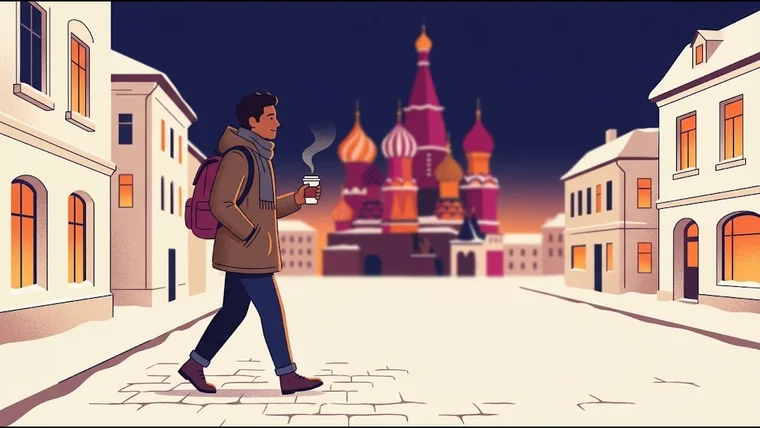
Russia is not for someone who grew up watching Disney and thinks the whole world works like in the movies. It is not a country made to fit Western culture, and it doesn't try to be.
If you think the Western way of seeing life is the only right one, you'll struggle a lot. Russia is for people with a wider outlook, people willing to understand another way of thinking without judging it from day one.
And that is well worth it. We all grow up thinking there is only one way to be. There isn't. As human beings we are alike in many things, but we see the world differently in many others. Living in Russia teaches you that all at once.
Russian makes you think differently
Spanish and English have a fairly similar structure. Ideas are built in roughly the same way, so going from one to the other is almost translating. With Russian it does not work like that.
Russian doesn't have the same grammatical forms, and many phrases have no literal translation. To really speak it you have to order your ideas differently, think differently. And once you understand how the language works, you start to understand how the culture works.
That's why the language is the first test. Whoever takes it as a challenge and not as a punishment is already halfway there.
What Russia gives you in return
Russia demands a lot, but it also gives a lot back. There I learned to be strong. I learned to be honourable. I learned the value of family. And above all I learned something Russians have like few other peoples: resilience.
It is that ability to survive adversity, pain and the worst tragedies, and still keep going with a brave face. It is a strength of the soul. I would dare say it is part of what people call the Russian soul.
That strength doesn't leave you. Problems and disasters will come for the rest of your life, but that inner strength stays with you.
The numbers: you will not be alone
My experience is one part. The other is the data, so you can see this is not some odd adventure.
- More than 400,000 international students from about 180 countries study at Russian universities, according to Deputy Prime Minister Dmitry Chernyshenko in June 2026.
- Every year the Russian government offers 30,000 tuition-free places for international students (the so-called quota), in place since 2023. You apply on the official Education in Russia portal.
- About three in four international students come from former Soviet countries, China and India, according to the Ministry of Science and Higher Education (data as of October 2025).
- There are around 5,000 students from Latin America and the Caribbean, an approximate figure published in 2023. In other words, Latin Americans are few, and that forces you to mix in and really learn the language.
Is Russia for you?
Russia is probably for you if:
- You like challenges and starting from scratch doesn't scare you.
- You're willing to learn a language very different from your own.
- You can live alongside another way of thinking without trying to change it.
- You want to come back different and stronger, not just with a degree.
And it probably is not if you want everything to work like at home, if every difference feels like a mistake to you, or if you expect the country to adapt to you.
If you're already considering it, see the numbers in: How much does it cost to study in Russia? →
If you learn to be Russian, Russia takes you in
Russia is for people willing to challenge themselves. In return, you take away a strength no classroom can teach. And there is something I always say: if you learn to be Russian, Russia will always take you in.
Frequently asked questions
Is it hard to adapt to Russia as a Latin American?
At first, yes: the language, the climate and the way people relate are very different. But those who arrive with an open mind and willing to learn usually adapt within the first year.
Do you need to know Russian before going to study in Russia?
It's not required. Most international students first do a preparatory language year at the university. But arriving with some basics helps a lot.
Why is Russian so hard for a Spanish speaker?
Because it has different grammatical forms, such as cases, and many phrases do not translate word for word. You have to learn to order your ideas differently.
Can foreigners study for free in Russia?
Yes, through the Russian government quota: 30,000 places a year that cover tuition. You apply on the official Education in Russia portal, usually months in advance. Housing, food and insurance are on you.
Sources
- Дмитрий Чернышенко: в российских вузах учатся более 400 тыс. иностранных студентов – Объясняем.рф (junio 2026)
- Interfax: estudiantes extranjeros en universidades rusas, datos del Minobrnauki (febrero 2026)
- Russia – LAC countries: Prospects for Educational Cooperation – HEDClub (2023)
- Education in Russia – portal oficial para extranjeros
Updated on 17 October 2026.

About the author
Giovanni Guadalupe
Consultant in digital marketing, imports from China and studying in Russia and China. I took my degree in Moscow, a master's in Minsk and another in Barcelona, and I speak Spanish, English and Russian.